Deep Ocean Dynamics
Overview
Due to density stratification, different regions of the ocean are often dynamically separated. However, cross-shelf exchange between the deep ocean and the continental shelf—and between the shelf and estuaries—occurs continuously and can be significantly intensified under specific conditions.
For instance, upwelling occurs in the western Gulf of Mexico during summer when upcoast winds (blowing from Mexico toward the Texas coast) drive offshore Ekman transport. Furthermore, when Loop Current Eddies (large anticyclonic rings shed from the Loop Current) encroach upon the shelf break, they transport warm water onto the shelf and impact baroclinic stability, triggering acute cross-shelf exchange. Closer to the inner shelf, these exchanges become even more dynamic due to the velocity shear between inner and outer shelf currents.
Our research addresses two critical questions:
- How does a warming climate impact the frequency and intensity of cross-shelf exchange?
- How do these changes affect the transport of nutrients, pollutants, and sediments?
To investigate these processes, we utilize:
- High-resolution long-term monitoring data (satellite imagery and mooring arrays).
- State-of-the-art large-scale ocean models (e.g., MOM6).
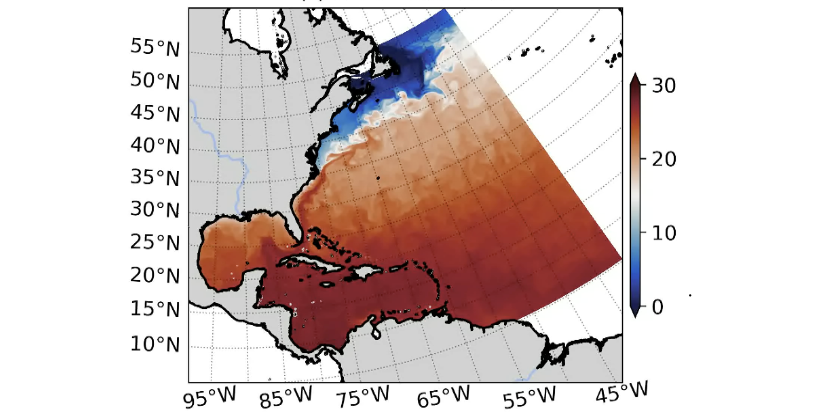 Figure 1: Snapshot of modeled sea surface temperature (SST) on 1993-01-01 using the MOM6 framework.
Study 01: Marine Heatwaves (Ongoing)
Marine heatwaves (MHWs)—defined as prolonged periods of abnormally warm sea surface temperatures exceeding a seasonally varying threshold—occur frequently in the Gulf of Mexico (GoM). They exhibit substantial spatial and dynamical diversity, reflecting the combined influence of basin-scale ocean memory, mesoscale circulation, and atmospheric forcing.
Despite their growing ecological and societal impacts, the physical mechanisms underlying different MHW “modes” remain poorly understood. This study identifies four distinct MHW spatial modes and examines how ocean preconditioning, local atmospheric forcing, and large-scale climate variability jointly shape their development and intensity.
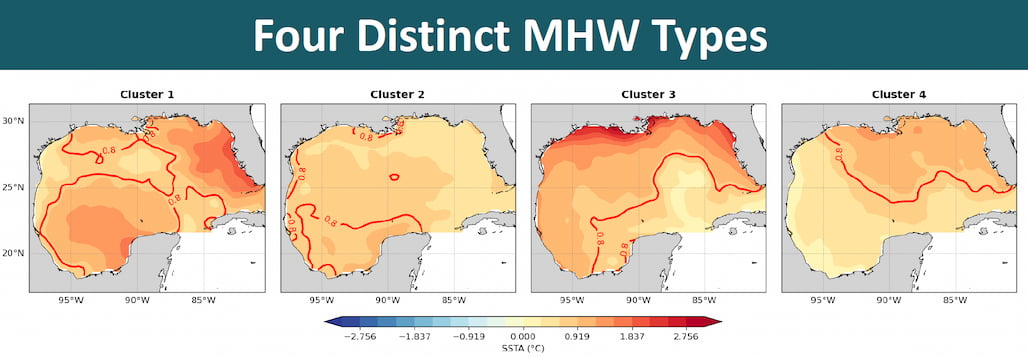 Figure 2: Four distinct marine heat wave types in Gulf of Mexico.
Study 02: Shelf-wide Circulation and Coastal Flushing (Hua et al. 2025)
While coastal flushing is primarily controlled by river discharge, tides, and local winds, deep-ocean dynamics—specifically shelf-wide circulation—can influence how quickly exiting water is transported away from bay mouths.
This study examines how varying spatial resolutions and model domains affect the representation of shelf-wide circulation and, consequently, flushing time estimates. A key takeaway is that failing to resolve shelf-wide circulation can cause coastal ocean models to significantly over- or under-estimate flushing times, depending on the season.
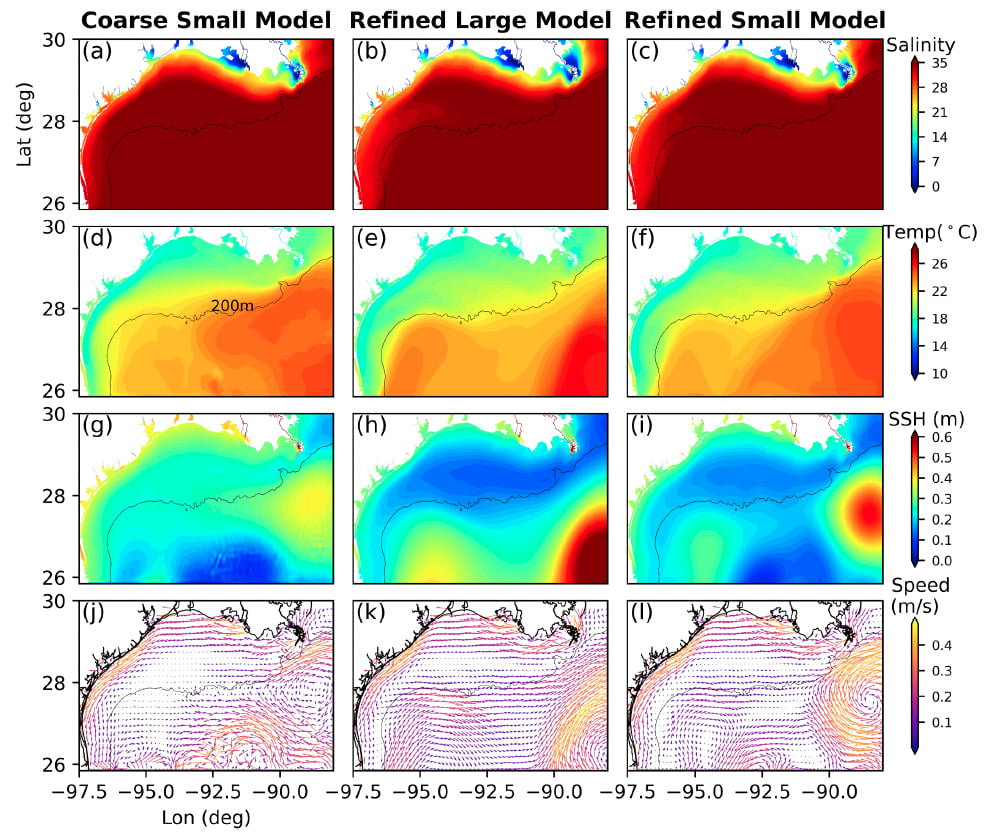 Figure 3: Surface salinity (top), surface temperature (second row), sea surface height (SSH; third row), and calculated geostrophic currents (bottom), averaged from January 31 to April 1, 2018.