Water Quality and Biogeochemical Modeling
Overview
As the climate warms and extreme weather events—such as hurricanes and marine heatwaves—become more frequent, there is increasing concern regarding water quality in coastal oceans. This is especially true for semi-enclosed estuaries where water renewal is slow and land-based stressors are high.
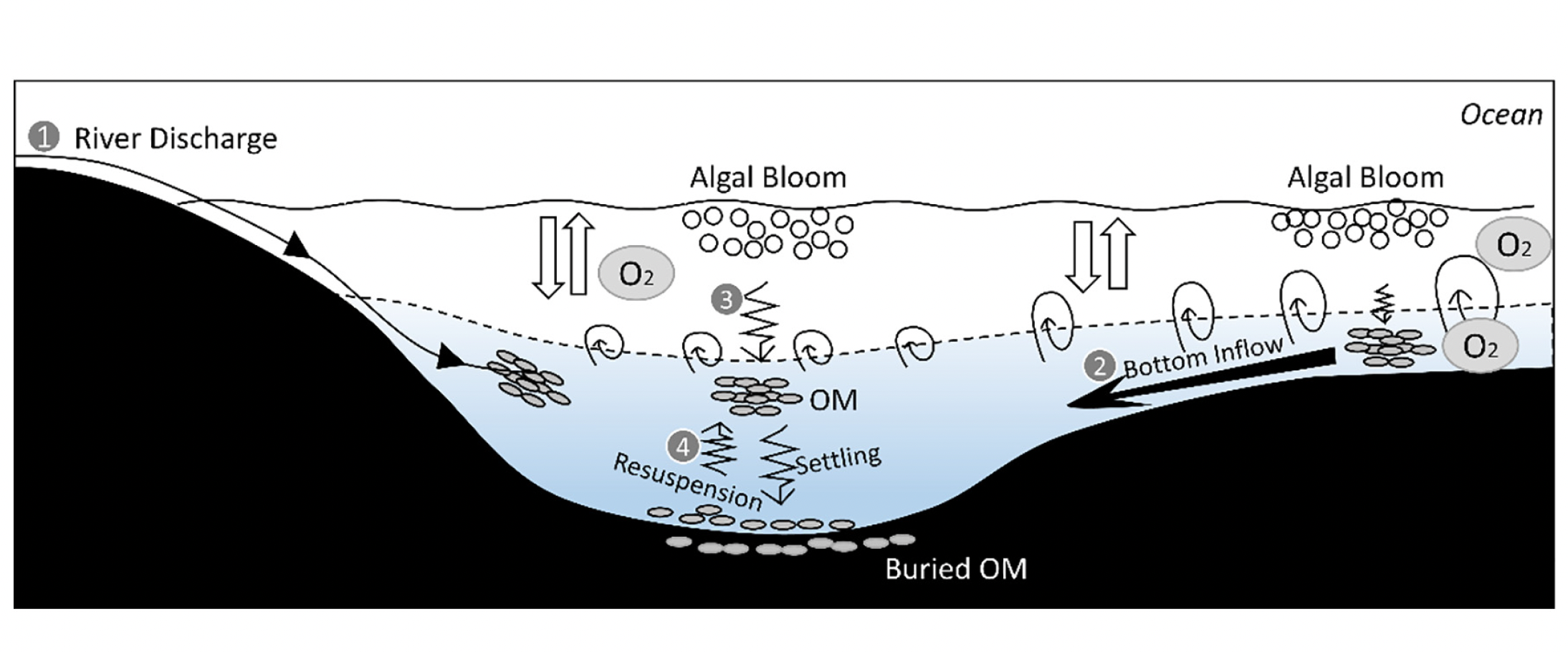
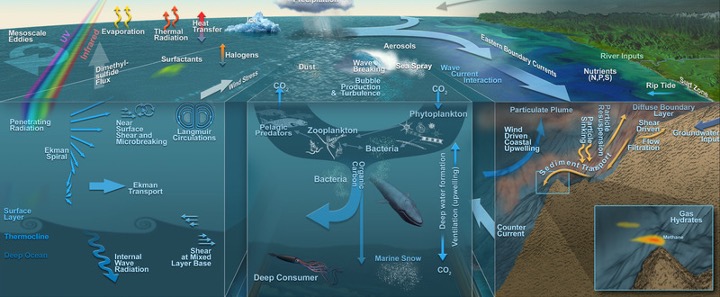
Our lab utilizes biogeochemical modeling to investigate observed water quality dynamics. These models use mathematical and computational tools to simulate the complex interactions between biological, chemical, and physical processes. By integrating these systems, we can better predict how nutrients, organic matter, and pollutants cycle through estuaries, lagoons, and coastal shelves.
Primary Components of Our Biogeochemical Models:
- Biological Processes: Modeling the growth, grazing, and decay of phytoplankton and zooplankton, and their metabolic interactions with the environment.
- Chemical Processes: Tracking the transformation and transport of dissolved oxygen, nutrients (nitrogen and phosphorus), and carbon within the water column and benthos.
- Physical Processes: Leveraging our hydrodynamic models (currents, tides, and mixing) to drive the distribution and residence time of biological and chemical tracers.
By coupling these processes, we gain insights into critical phenomena such as harmful algal blooms (HABs), oxygen depletion (hypoxia), and the impacts of anthropogenic activities—such as agriculture and urban runoff—on coastal health.
Study 01: Coastal Hypoxia
Hypoxia (low dissolved oxygen) is a persistent threat to marine life in the Northern Gulf of Mexico and its surrounding estuaries. Our research focuses on how physical stratification and nutrient loading interact to create “dead zones.” We use high-resolution models to pinpoint the drivers of oxygen depletion and estimate the recovery time of these systems after major storm events.